
Container Gardens
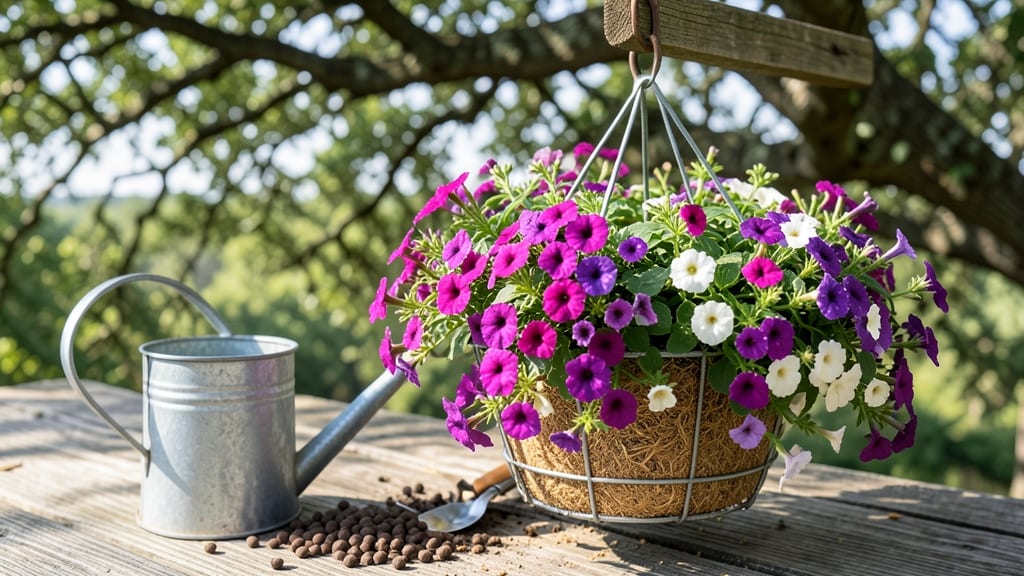
If you’ve ever dreamed of a porch or balcony bursting with nonstop color—think tiny, star-shaped blooms spilling over every edge—then how to care for calibrachoa hanging baskets is your secret weapon. But here’s the catch: these showstoppers demand just the right care to keep them thriving, not just surviving.
I’ve spent years perfecting the art of calibrachoa care, and the difference between wilting disappointment and year-round vibrancy often comes down to three key factors: sunlight, watering, and deadheading.
Skip these, and you’ll end up with leggy stems and sparse blooms. Nail them, and your baskets will be the talk of the neighborhood.
In this guide, I’ll walk you through everything from how often to water (hint: it’s more frequent than you think) to the deadheading tricks that extend blooms well beyond summer.
Whether you’re a first-time container gardener or a seasoned pro, these tips will help you keep your calibrachoa looking fresh, full, and fabulous—no matter the season.
Ready to turn your hanging baskets into a flowering oasis? Let’s dive into the exact steps that’ll have your calibrachoa thriving from spring through fall—and maybe even beyond.
Calibrachoa hanging basket care: sunlight, watering, and soil essentials for nonstop blooms
Your calibrachoa thrives in hanging baskets because they mimic its natural trailing habit, but only when you nail the basics. These sun-loving annuals demand precise care—too much shade or soggy soil, and you’ll watch those vibrant blooms fade faster than a summer sunset.
Let’s break down the three pillars of calibrachoa care: sunlight, watering, and soil, so your baskets stay lush and overflowing all season.
First, sunlight is non-negotiable. Calibrachoa craves 6+ hours of direct sun daily, but afternoon shade in scorching climates prevents leaf scorch.
If your balcony faces west, rotate baskets weekly so all sides get even light. Partial shade (3–6 hours of sun) will stretch stems and reduce blooms—think leggy, sad plants instead of your dream cascading waterfall of flowers.
Watering is where most gardeners trip up. Hanging baskets dry out 2–3x faster than ground soil, so check moisture daily during peak summer heat. Stick your finger 1 inch deep—if it’s dry, water thoroughly until it drains from the bottom. Morning watering is key: it prevents fungal diseases by letting foliage dry before nightfall. Overwatering? That’s how you get root rot, which turns your pretty baskets into a sad, mushy mess.
| Care Factor | Best Practice | Common Mistake |
|---|---|---|
| Sunlight | 6+ hours direct sun; rotate baskets weekly | Partial shade → leggy growth |
| Watering | Daily in summer; morning watering only | Night watering → fungus risk |
| Soil | Well-draining peat-based mix + perlite | Heavy clay soil → root rot |
| Fertilizer | Balanced 10-10-10 every 4–6 weeks | Over-fertilizing → burned roots |
| Baskets | 12–18" diameter with drainage holes | Small baskets → dries too fast |
Now, let’s talk soil. Calibrachoa roots need oxygen-rich, fast-draining soil—think peat moss or coco coir mixed with perlite or vermiculite. A 50/50 blend of potting mix and sand works wonders. Avoid garden soil; it compacts and suffocates roots.
Pro tip: Add a slow-release fertilizer like Osmocote at planting time for a 3-month nutrient boost. And here’s a secret: Sphagnum moss on top retains moisture while keeping roots cool.
Your basket size matters too. Aim for 12–18 inches in diameter—smaller baskets dry out in hours, while oversized ones hold too much moisture. Line baskets with sphagnum moss to wick water to roots and prevent soil from spilling.
And double-check drainage holes: no holes = no happy calibrachoa. If you’re repurposing old baskets, scrub them with a 10% bleach solution to kill fungi or bacteria lurking from last season.
Finally, fertilizing keeps blooms coming. Use a balanced liquid fertilizer (like 10-10-10) every 4–6 weeks, but cut back in fall. Overdoing it causes salt buildup, which burns roots. For a natural boost, top-dress with worm castings in spring.
And here’s a trick: Fish emulsion (diluted to 1 tbsp per gallon) gives a quick phosphorus kick for more blooms. Just don’t fertilize if soil is dry—always water first!
Putting it all together, your calibrachoa hanging baskets will reward you with nonstop blooms if you give them sun, water, and soil that mimics their wild, trailing habitat.
Next up: deadheading to keep those flowers coming like clockwork—because even the best care won’t help if you’re not pinching those spent blooms!
Deadheading calibrachoa: the proven tricks to extend blooming season beyond summer
Deadheading—removing spent blooms—is the secret weapon for year-round calibrachoa blooms. These flowers are prolific but need encouragement to keep producing. Without deadheading, your baskets will shift from vibrant cascades to leafy green monsters in weeks.
The key is consistency: check your baskets daily during peak bloom (June-August) and every 2-3 days in shoulder seasons.
There are three proven deadheading methods for calibrachoa: pinching, snipping, and the 'spoon method'. I’ve tried all three, and each works for different situations. Pinching (using your fingers) is best for small batches or when you’re traveling—just crush the stem between your thumb and forefinger.
For larger baskets, sharp pruners are faster and cleaner. The 'spoon method' (curving your fingers like a spoon to scoop out faded blooms) is my go-to for quick maintenance.
- 👆 1. Finger Pinching – Best for small clusters or travel days. Crush stems at base to redirect energy.
- ✂️ 2. Sharp Pruners – Use for large baskets or thick stems. Cut 1/4 inch above a leaf node.
- 🤲 3. Spoon Method – Curve fingers to scoop out faded blooms without tools. Ideal for quick checks.
- ⏰ 4. Morning Deadheading – Always do it in the morning to avoid evening moisture on cuts.
- 🌞 5. Weekly Pruning – Every 7-10 days, trim 1/3 of leggy stems to encourage bushiness.
Timing matters just as much as technique. Deadhead first thing in the morning to let wounds dry before evening humidity sets in—this prevents fungal infections. If you’re away for a weekend, a light pinch every other day keeps blooms coming.
Pro tip: Rotate your baskets weekly so all sides get even sunlight, which boosts uniform blooming.
Don’t make the mistake of waiting until blooms fully brown—by then, the plant has already wasted energy on seed production. Aim to deadhead when 20-30% of petals have fallen.
I once let a basket go for 10 days without deadheading, and within weeks, it was half leaves. Lesson learned: consistency wins.
For extended blooming, pair deadheading with regular feeding. Use a balanced fertilizer (10-10-10) every 4-6 weeks during growing season.
The combo of pruning + nutrients tells your calibrachoa: “Keep blooming, don’t go dormant!” In my Zone 8a garden, this keeps my baskets flowering until October.
If you’re overwintering your calibrachoa, reduce deadheading to once every 2 weeks in fall. Let a few blooms go to seed—this stimulates natural dormancy and prepares the plant for indoor care.
By December, you’ll only need to remove dead leaves, not flowers. Patience pays off when spring rolls around!